



2026∼2030 Economic Five-Year Plan Confirmed…Expected to Emphasize ‘Domestic Demand Activation and Advanced Technology Development’
U.S.-China Summit Pre-check of Foreign Policy…International Attention on Messages Regarding Taiwan, Japan, and North Korea,
,
, ![Chinese President Xi Jinping [EPA Yonhap News File Photo. No resale or database storage]](https://imgnews.pstatic.net/image/001/2026/03/01/PEP20211112030501009_P4_20260301070015605.jpg?type=w860)
Chinese President Xi Jinping
[EPA Yonhap News File Photo. No resale or database storage],
,
, ‘(Beijing=Yonhap News) Correspondent Jung Sungjo = China’s annual largest political event, the Lianghui (Two Sessions – National People’s Congress and Chinese People’s Political Consultative Conference), will open this week.’,
,
, ‘The Lianghui is an event that presents China’s economic and social development goals and tasks at the beginning of the year and confirms the intentions and policy directions of the top leadership. Various messages, from fiscal management to foreign positions, are outlined.’,
,
, ‘This year’s Lianghui is drawing attention due to the necessity to formalize the beginning of the 15th Five-Year Plan (2026∼2030) in the face of challenges such as economic slowdown, domestic demand contraction, and the U.S-China conflict. There is a focus on long-term development strategies, such as nurturing science and technology and system reform.’,
, ![The Great Hall of the People where Lianghui is held [Yonhap News File Photo. No resale or database storage]](https://imgnews.pstatic.net/image/001/2026/03/01/PYH2022030505460008300_P4_20260301070015610.jpg?type=w860)
The Great Hall of the People where Lianghui is held
[Yonhap News File Photo. No resale or database storage],
,
Held every March, NPC & CPPCC…Formalizing Main Plans like Growth Rates and Budgets , ‘”Lianghui” means “two meetings.” It refers to the National People’s Congress (NPC), the highest legislative body under the Chinese Constitution, and the Chinese People’s Political Consultative Conference (CPPCC), which acts as a political advisory body.’,
,
, ‘It became an annual event in 1959, and since 1985 it has been customary to hold it in March, except for in 2020, when the pandemic delayed it to May. Every year, Lianghui is held in early March.’,
,
, ‘This year, the CPPCC opens first on March 4, followed by the NPC on March 5 in Beijing, with about a week-long schedule.’,
,
, ‘The NPC is comprised of 2,977 deputies from provinces, autonomous regions, directly controlled municipalities, special administrative regions, the military, and ethnic minorities.’,
,
, ‘On the opening day of the NPC each year, the government work report, which is a “highlight,” is presented. It is a process to review and approve the annual economic growth target, priority of government work, sector-specific budget plans such as national defense by the deputies.’,
,
, ‘This year’s NPC will also present the 15th Five-Year Plan, which includes a blueprint for economic and social development over the next five years.’,
,
, ‘Interest also lies in the foreign minister’s press conference during the NPC, which broadcasts China’s foreign policy to the world, and statements from ministerial-level officials explaining their positions.’,
,
, ‘Opening a day earlier than the NPC, the CPPCC consists of over 2,000 representatives from 34 fields including members of the Communist Party of China, other political parties, independents, ethnic minorities, various organizations, scientists, entrepreneurs, and artists.’,
,
, ‘Although nominally a top-level national body, it does not hold real power and functions to build broad social consent on already confirmed policy directions, supporting “party leadership.”‘,
, ![Food delivery workers in Beijing, China [EPA Yonhap News File Photo. No resale or database storage]](https://imgnews.pstatic.net/image/001/2026/03/01/PEP20240914093501009_P4_20260301070015613.jpg?type=w860)
Food delivery workers in Beijing, China
[EPA Yonhap News File Photo. No resale or database storage],
,
‘Maintaining a 5% Growth’ Goal Despite Economic Slowdown Expected , ‘Key points in this year’s Lianghui include China’s medium- and long-term economic and industrial plans.’,
,
, ‘The Communist Party of China highlighted “maintaining economic growth in a reasonable range” and “leading role of domestic demand” as major goals in the “Proposal for Formulating the 15th Five-Year Plan” confirmed last October.’,
,
, ‘This reflects concerns about the ongoing domestic demand slump and economic slowdown that have lingered post-pandemic.’,
,
, ‘China has consistently set a “around 5%” growth target over the past three years, achieving actual growth rates of 5.2%, 5.0%, and 5.0% respectively.’,
,
, ‘Amid employment difficulties and income declines, the government has injected fiscal resources into exports exposed to the “tariff war” and subdued consumption, ensuring the achievement of the growth target even at the cost of industry-wide excess production and competition.’,
,
, ‘There is recognition within China that maintaining such a high target is increasingly difficult. Results from local Lianghui held before the national Lianghui show that out of 31 provinces and cities, 21 have lowered their growth targets compared to last year.’,
,
, ‘However, it is widely expected that the 15th Five-Year Plan period, including this year, will maintain the “around 5%” growth target.’,
,
, ‘Hu Angang, a Tsinghua University scholar, and the “brain” of China’s leadership, pointed in a recent report to population aging, economic negative impacts from the real estate market slump, and U.S.-China relations uncertainty as unfavorable factors for the next five years. He stated, “Setting the economic growth target at around 5% is reasonable for the 15th Five-Year Plan” and “flexibility exists in the target growth, meaning efforts can achieve it if the average growth rate reaches above 4.5%.’,
,
, ‘Though likely to fall short of the 14th Five-Year Plan (2021-2025) average economic growth rate of 5.4%, the target set at “around 5%” is achievable with effort.’,
,
, ‘In a challenging situation, the top priority in the forthcoming discussions at this Lianghui is expected to be exploring and nurturing drivers to deliver growth amidst adversity.’,
,
Science and Advanced Technology Likely to be Key Again This Year, ‘At the Politburo meeting chaired by General Secretary Xi Jinping (President) last month, the Communist Party of China discussed the outline of the 15th Five-Year Plan and the government work report draft, presenting tasks such as domestic demand activation, supply reform, breaking down regional market segmentation, and accelerating scientific and technological self-reliance and strength.’,
,
, ‘The emphasis on strategically developing “Liangzhong” (national major strategy and major projects) and “Liangxin” (new quality production strength and new consumption), as well as advanced technology, is expected to continue.’,
,
, ‘At last year’s Lianghui, terms like “embodied intelligence” (robots equipped with AI that interacts with the real environment) and 6G, humanoid robots appeared massively in the government work report for the first time. Economic ministers at joint press conferences promoted AI model DeepSeek as an example of overcoming U.S. technology control and announced plans for a national entrepreneurship investment fund amounting to 1 trillion yuan (approximately 210 trillion won) to boost the atmosphere.’,
,
, ‘Though domestic demand and investment are slowing, spending in defense and scientific and technological fields is expected to increase in scale.’,
,
, ‘Chinese defense spending has surged since Xi Jinping took power in 2013, with a 7.1% increase in 2022, and consistent 7.2% increases from 2023 to 2025.’,
,
, ‘Last year, China emphasized long-term growth and strategic importance over short-term profit recovery in research and development (R&D), budgeting 398.1 billion yuan (about 84 trillion won), a 10% increase from the previous year.’,
, 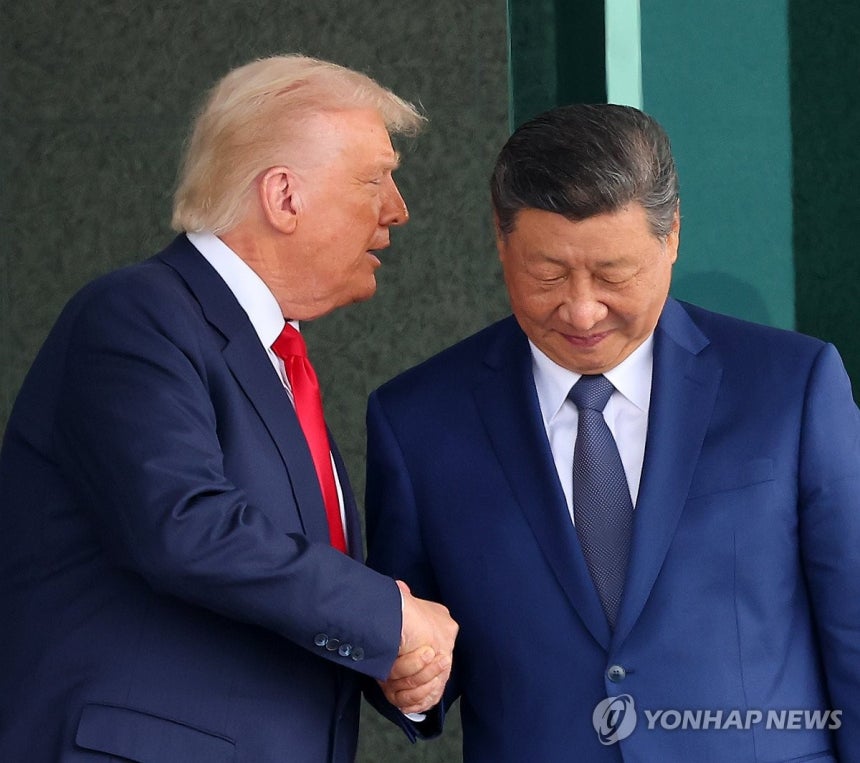
End of U.S.-China Summit
(Busan=Yonhap News) Reporter Son Hyungju = Former U.S. President Donald Trump and Chinese President Xi Jinping leaving the meeting room after the U.S.-China summit at Kimhae Airbase in Busan. October 30, 2025,
,
Before the U.S. Summit, ‘Stabilizing Relations’…Focus on Mention of Korean Peninsula and North Korea’s Nuclear Issue , ‘With Former U.S. President Donald Trump’s planned visit to China at the end of March to early April, interest lies in what foreign policy China will announce.’,
,
, ‘Foreign Minister Wang Yi (Head of the Office of the Central Commission for Foreign Affairs) conveyed a dual message during last year’s Lianghui, affirming a robust stance against the Trump administration’s tariff threats while acknowledging the need for U.S.-China cooperation.’,
,
, ‘This year, with the U.S. Supreme Court ruling against reciprocal tariffs, which has impacted Trump’s unilateral tariff approach, China could confidently emphasize “relations stabilization,” leveraging its strategies against the U.S., such as the weaponization of rare earths, trade diversification, and advanced technology enhancement.’,
,
, ‘As the U.S.-China summit approaches, a clearer demand regarding the Taiwan issue, seen as the “core of the core interests,” such as stopping U.S. arms sales, could arise. There is also the possibility of sharp criticism toward Japanese Prime Minister Sanae Takaichi, who recently fueled tensions with China by making comments suggesting intervention in a potential Taiwan contingency.’,
,
, ‘Attention also focuses on whether the Korean Peninsula issue, not mentioned separately last year, will be discussed.’,
,
, ‘Wang clarified China’s Korean Peninsula policy as “dual-track progress (denuclearization and North Korea-U.S. peace agreement promotion) with a staged and simultaneous principle” during the 2024 Lianghui, but China has recently remained officially silent on North Korea’s nuclear possession issue.’,
,
, ‘xing@yna.co.kr’,
,
,
China’s “Two Sessions” Open This Week: Attention on Medium- to Long-Term Growth Strategy Amid Economic Slowdown


Visited 18 times, 1 visit(s) today