



Civil Servants 5.3% vs. Citizens 57.6%… Ongoing Perception Gap,

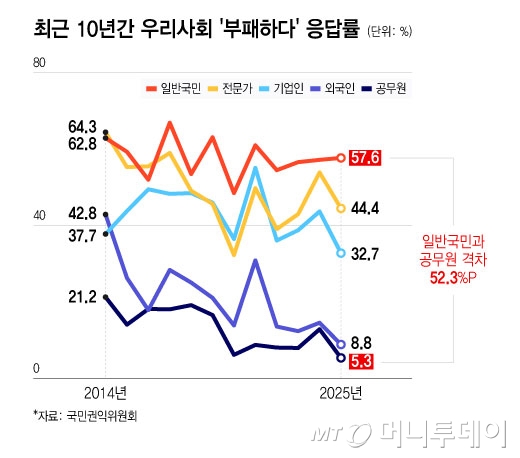
Response rate of ‘corruption in society’ over the past 10 years/Graphic by Yoon Sun-jung, ‘The perception of the level of corruption in Korean society has improved across most groups, including businesspeople and public officials. However, 6 out of 10 ordinary citizens still perceive the society as corrupt, showing an ongoing perception gap between the public and civil servants.’,
,
, “The Anti-Corruption and Civil Rights Commission (ACRC) announced the results of the ‘2025 Corruption Perception Survey’ conducted on January 13, targeting a total of 4,530 people, including ordinary citizens, businesspeople, experts, foreigners, and public officials.”,
,
, “According to the survey results, the rate of response indicating that ‘our society is corrupt’ was highest among ordinary citizens at 57.6%. This was followed by experts (44.4%), businesspeople (32.7%), foreigners (8.8%), and civil servants (5.3%). Compared to the previous year, the perception of corruption decreased significantly among businesspeople (↓10.9%p), experts (↓9.4%p), civil servants (↓7.5%p), and foreigners (↓5.7%p). However, for ordinary citizens, the figure rose by 0.5%p, widening the gap with civil servants, who had the lowest perception of corruption, from 44.3%p the previous year to 52.3%p.”,
,
, “In particular, the percentage of civil servants perceived as ‘corrupt’ was again highest among ordinary citizens (39.1%), followed by experts (30.8%), businesspeople (22.6%), foreigners (8.8%), and civil servants (1.1%). Compared to the previous year, improvements were seen among businesspeople (↓9.3%p), foreigners (↓5.4%p), experts (↓5.3%p), and civil servants (↓2.0%p), but the perception gap between civil servants and ordinary citizens remained large.”,
,
, ‘Regarding the perception gap between citizens and civil servants, an ACRC official stated, “It seems that ordinary citizens and other survey subjects perceive more corruption due to news reports focusing on elected officials. Meanwhile, civil servants apparently think that the public’s perception level or expectations regarding corruption have somewhat increased.”‘,
,
, “In terms of corruption perception by social sector, the ‘political parties and legislature’ sector was seen as the most vulnerable. Ordinary citizens, experts, and public officials all identified this sector as the most corrupt. In contrast, businesspeople pointed to the ‘media’ sector, while foreigners identified ‘religious organizations’ as the most corrupt, highlighting the differences in perspectives among groups. Conversely, citizens, businesspeople, and experts rated the ‘education’ sector as the most clean, while foreigners and public officials viewed ‘culture, arts, and sports’, and ‘administrative agencies’, respectively, as the least corrupt.”,
,
, “In terms of administrative sectors, ordinary citizens, businesspeople, and public officials rated ‘prosecution, correction, and law affairs’ as the most corrupt, while experts highlighted ‘construction, housing, and land’. All groups assessed the ‘fire department’ sector as the most clean.”,
,
, “The perception of ‘fairness’ has generally improved. The rate of responses indicating that our society is unfair decreased across all survey subjects compared to the previous year. In particular, the perception of ‘unfairness’ among businesspeople and civil servants improved remarkably, decreasing by 9.8%p and 9.1%p, respectively.”,
,
, “Positive signals were also detected regarding the effectiveness of the government’s anti-corruption policies. The perception that these policies were effective increased across all groups, with businesspeople showing a notable rise of 27.0%p in positive responses. Expectations that corruption levels will decrease in the future also significantly increased.”,
,
, ‘Lee Myung-soon, vice-chairperson of the ACRC, stated, “The active implementation of the government’s anti-corruption policies is spreading positive perceptions of integrity and fairness throughout society. We take seriously the point that the perception of corruption among ordinary citizens is still lacking and will do our utmost to enable citizens to experience the results in their daily lives.”.’