

The Issue of Electrolyte Interface Cracking at High Temperatures
Solved with Composite Material Design and Process for Large Area Application
CO₂ Electrolysis Performance Improved by 3.6 Times Compared to Existing Systems
Expected to be Used in Industrial Systems for Aviation Fuel and Plastic Raw Materials,
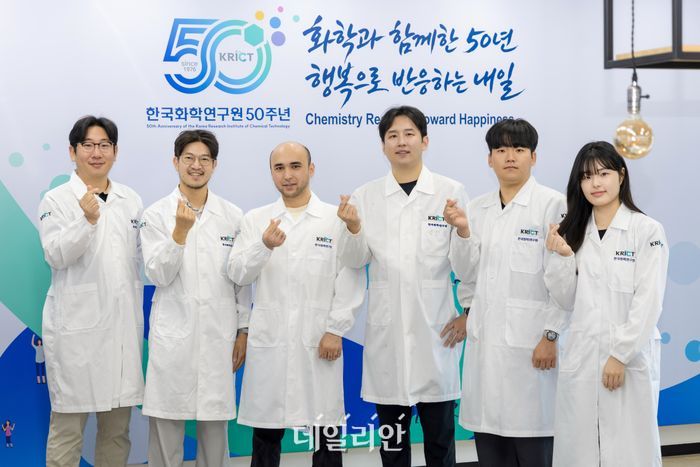
The research team of Dr. Kim Min-chul, Dr. Park Ji-hoon, and Dr. Lee Jin-hee from the Korea Research Institute of Chemical Technology is taking a commemorative photo. © Korea Research Institute of Chemical Technology, ‘[Dailyan = Reporter Kim Ji-hyun] A domestic research team has solved the durability issue of the solid oxide electrolyzer cell (SOEC) used to convert carbon dioxide (CO₂) into high-value chemical raw materials.’,
,
, ‘The problem of the electrolyte interface, which easily cracked at high temperatures, was solved through composite material design and a process that facilitates scaling up. It is expected to be used in large-scale industrial systems for converting CO₂ into aviation fuel and plastic raw materials.’,
,
, ‘The Korea Research Institute of Chemical Technology announced on the 24th that the team of Dr. Kim Min-chul, Dr. Park Ji-hoon, and Dr. Lee Jin-hee developed a manufacturing technology that re-designs the structure of the nickel-based SOEC’s internal electrolyte interface to prevent cracking during high-temperature operation, enabling efficient conversion of CO₂ to carbon monoxide (CO).’,
,
, ‘An SOEC is a device that converts CO₂ to CO by applying electricity. The CO produced can be used as a key raw material for synthesis gas (carbon monoxide + hydrogen), which is utilized in the production of sustainable aviation fuel, methanol, plastics, and industrial chemical materials.’,
,
, ‘The oxygen ion conductive electrolyte material positioned between the electrodes is critical for SOECs. Recently, high-performance SOECs often use both YSZ and GDC materials.’,
,
, ‘YSZ has low oxygen ion mobility but good durability, while GDC has high ion mobility but lower durability, complementing each other’s CO₂ conversion performance.’,
,
, ‘However, the difference in thermal expansion rates between the two electrolyte materials causes interfacial delamination as they expand and contract differently at high temperatures, leading to performance degradation and reduced lifespan during long-term operation.’,
,
, ‘There are methods to address this issue using expensive equipment-based deposition techniques (such as PVD, PLD), but these entail high manufacturing costs and difficulties in large-area commercialization.’,
,
, ‘The research team reduced the interfacial delamination phenomenon by forming a composite intermediate layer of mixed electrolyte powders using a simple dip coating method instead of costly processes.’,
,
, ‘As for the Faraday efficiency, which indicates how much of the input electricity is actually used to convert CO₂ to CO, existing SOECs were at a level of 80-90%.’,
,
, ‘The SOEC developed with this new technology maintained 91% of its initial performance after continuous operation at a high load condition of 1.6V for 80 hours, demonstrating high durability and world-class Faraday efficiency.’,
,
, ‘The “current density,” reflecting how quickly CO₂ can be processed per unit area, also improved approximately 3.6 times from the existing 0.59 to 2.14 amperes per square centimeter (A/cm²), showcasing the highest processing capability among nickel-based SOECs in conjunction with high Faraday efficiency.’,
,
, ‘Through the paper, the research team verified conditions scalable to large areas with coin-sized small cells, and is currently expanding research to “flat-tubular cells” the size of a smartphone.’,
,
, ‘Since the technology employs a process that enables large-area manufacturing without the need for expensive equipment, it is expected to be advantageous for expanding electricity-based industrial CO₂ resource conversion facilities in the future.’,
,
, ‘However, additional research is needed for commercialization, such as the production of large stacks and ensuring connectivity with renewable energy.’,
,
, ‘Director Shin Seok-min stated, “This achievement resolves the durability issues that hindered both CO₂ conversion efficiency and commercialization of solid oxide electrolyzer cells at once.”’,
,
, ‘The findings were published as a back cover paper in the international journal “Advanced Science” in March.’,
,
, ‘Meanwhile, the research was conducted with support from the Chemical Research Basic Project and the Industrial Fine Dust Intelligent Optimal Reduction and Management R&D project by the Korean Ministry of Environment and the Korea Environment Industry & Technology Institute.\n’