

President Lee, Gwangju and Jeonnam National Assembly Members and Local Government Heads Luncheon
February Special Law, June Unified Local Government Head, Financial Privileges, Resident Voting, etc. Under Scrutiny,
![[Gwangju=Newsis] Reporter Lee Young-ju: Kang Ki-jung (right), Mayor of Gwangju, and Kim Young-rok, Governor of Jeollanam-do, are taking a commemorative photo after reading the Gwangju-Jeonnam Integration Promotion Joint Declaration at the National May 18th National Cemetery in Buk-gu, Gwangju, on the morning of the 2nd, 2026.01.02](https://imgnews.pstatic.net/image/003/2026/01/05/NISI20260102_0021112618_web_20260102093554_20260105111523742.jpg?type=w860)
[Gwangju=Newsis] Reporter Lee Young-ju: Kang Ki-jung (right), Mayor of Gwangju, and Kim Young-rok, Governor of Jeollanam-do, are taking a commemorative photo after reading the Gwangju-Jeonnam Integration Promotion Joint Declaration at the National May 18th National Cemetery in Buk-gu, Gwangju, on the morning of the 2nd, 2026.01.02. [email protected],
,
, ‘[Gwangju=Newsis] Reporter Song Chang-heon: As the Gwangju-Jeonnam administrative integration is gaining momentum, a luncheon meeting scheduled for the 9th between President Lee Jae-myung and National Assembly members from the Gwangju-Jeonnam area is expected to be the biggest turning point.’,
,
, ‘Attention is focused on the election of a unified local government head in June, the passage of a special law in February, and agreements on radical financial privilege provisions to address severe local financial difficulties, with the implementation of a resident vote emerging as a significant variable.’,
,
, ‘According to local political circles, President Lee Jae-myung plans to invite 18 Democratic Party National Assembly members from the Gwangju-Jeonnam constituencies, along with Gwangju Mayor Kang Ki-jung and Jeonnam Governor Kim Young-rok, to a luncheon at the Blue House on the 9th.’,
,
, “This meeting is being arranged as the president’s direct response to the ‘Gwangju-Jeonnam Integration Promotion Joint Declaration’ announced by the Gwangju Mayor and the Jeonnam Governor on the 2nd, and it is expected to accelerate the unification movement.”,
,
, “During the meeting, opinions are expected to be coordinated between the party and government regarding the ‘Gwangju-Jeonnam Administrative Integration Roadmap,’ which aims to elect the Gwangju-Jeonnam unified local government head in the June 3rd local elections and officially launch the unified local government on July 1st.”,
,
, “One of the core issues is expected to be the promise of prompt legislative support to pass the ‘Special Act on the Establishment of the Gwangju-Jeonnam Super-regional Special Autonomous Province,’ currently pending before the National Assembly’s Public Administration and Security Committee, during the February temporary session of the National Assembly.”,
,
, ‘There is keen interest in how deeply and to what extent the central government’s extraordinary financial privileges, such as tax exemptions and administrative incentives for fiscal decentralization and expanded autonomy, will be discussed.’,
,
, ‘Gwangju and Jeonnam have financial independence ratios in the 30% and 20% range, respectively, which are among the lowest in the nation, and their fiscal autonomy is weak, with high dependence on the central government. In response, Gwangju City and Jeonnam Province have persistently demanded an increase in the local grant tax rate from the current 19.24% to 24.24% through legislative amendment.’,
,
, ‘There are also constant calls to raise the local consumption tax rate, i.e., the proportion of value-added tax transferred to local taxes, from the current 25.3% to 45-50%.’,
,
, ‘Representative Jeong Joon-ho (Gwangju Buk-gu Gap), who proposed the special law, said, “For example, there can be different agreements, such as raising the local grant tax ratio to 6.5% or increasing the local consumption tax to 45%, all under the assurance of a ‘regional specialization model,’ which is of interest.”‘,
,
, “Resident voting is also crucial. Under the current Resident Referendum Act, an administrative integration requires that at least a quarter (25%) of the total eligible voters participate in the vote, with a majority approval of the valid votes. However, due to the lack of time before the June elections, there is also considerable opinion that a ‘local council resolution’ could replace a resident vote.”,
,
, ‘Representative Jeong said, “The most desirable way for a swift integration is to substitute resident voting with the resolution of both city and provincial councils, but it is not easy,” and added, “Resident voting seems to be the first phase of the front line battle.” “A regional assembly is expected to clear up some issues by as early as the 7th, before the Blue House meeting,” he added.’,
,
, ‘Besides, the process of publicizing the integration, the name of the unified local government, the location of the office, the election of the unified chairperson, and the question of whether to elect a unified superintendent are expected to be decided in more detail through discussions within the integration consultative body.’,
,
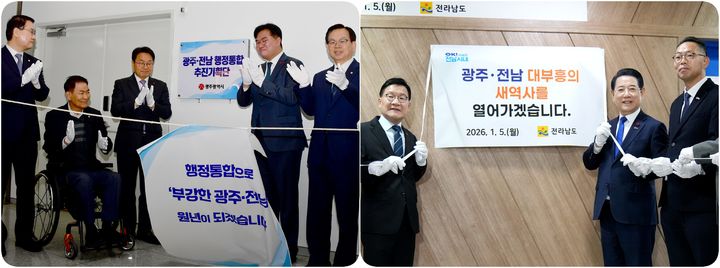
, ‘Meanwhile, Gwangju City and Jeonnam Province held nameplate ceremonies for the administrative integration promotion planning teams and officially began their activities today.’,
,
,
* No resale or DB storage allowed,
,
,