

Different wavelengths of light independently control memory enhancement and reduction
Potential applications in artificial retinas for visual memory,
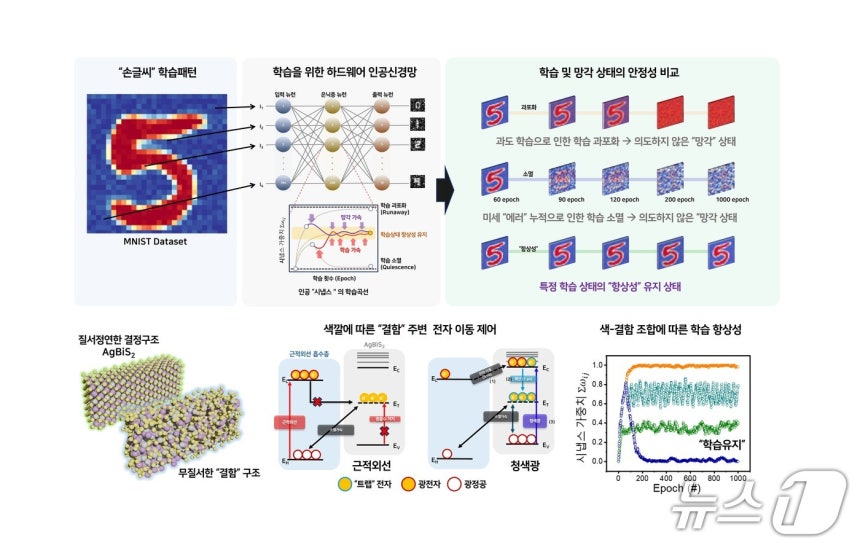
A brain-mimicking photonic synapse that adjusts ‘memorization’ and ‘forgetting’ with light colors. (Provided by Professor Cho Sae-byeok of Sungkyunkwan University. Resale and DB prohibited)June 10, 2026/News1,
,
, ‘(Daejeon=News1) Reporter Lee Dong-won = A domestic research team has developed a photonic synapse platform that enables AI semiconductors to strengthen or weaken memory based on the color of light.’,
,
, “Unlike existing photonic synapses that controlled ‘memorization’ and ‘forgetting’ with a single switch, this platform independently implements these two functions.”,
,
, ‘The Korea Research Foundation announced on the 10th that a joint research team comprising Professor Cho Sae-byeok and Professor Yang Woo-suk from Sungkyunkwan University and Professor Jo Jeong-ho from Yonsei University has developed a new photonic synapse platform that independently implements memory strengthening and weakening based on the wavelength of light.’,
,
, ‘A photonic synapse is a next-generation semiconductor that mimics the synapses of the human brain using light signals, utilizing light instead of electricity in the process of learning and remembering information. The advancement achieved is overcoming the previous limitation of controlling both memorization and forgetting with a single switch, enabling separate control of these functions.’,
,
, “The research team used a material previously regarded as ‘defective’, silver bismuth sulfide (AgBiS₂), as a means to maintain memory balance. This involves implementing a storage role for electric signals in the subtle defects of the material where current flow slows, with a heterojunction structure that stacks molecular layers capable of selectively absorbing near-infrared light on a nanometer scale being key.”,
,
, ‘This structure alters the speed and direction of electron movement based on the light color, accelerating synapse strengthening and memorization with near-infrared light while quickly facilitating memory weakening with blue light. Experiments confirmed that synapse strength increased more than 13-fold.’,
,
,

From left: Professor Cho Sae-byeok, Associate Professor of Chemical Engineering at Sungkyunkwan University (corresponding author), Professor Yang Woo-suk, Associate Professor of Chemical Engineering at Sungkyunkwan University (co-corresponding author), Kim Hyun-woo, researcher at Sungkyunkwan University (first author), Ha-neul, a student in the integrated master’s and doctoral program at Sungkyunkwan University (co-first author). (Provided by the Korea Research Foundation. Resale and DB prohibited)June 10, 2026/News1,
,
, ‘This technology is expected to have widespread applications in next-generation AI semiconductors such as low-power AI chips, optical-based neuromorphic computing, visual memory-retaining artificial retinas, and visual cognition systems for autonomous driving and robotics.’,
,
, ‘Professor Cho Sae-byeok commented, “This meaningful research turns previously discouraged disordered defects in semiconductors into a feature where AI maintains memory balance itself,” adding, “It will significantly contribute to the advancement of low-power AI semiconductor technology in the future.”‘,
,
, “The research results were published in the May 18 issue of the internationally renowned journal ‘Nature Communications.’ The study was supported by the Ministry of Science and ICT and the Korea Research Foundation’s Excellence in New Researcher Program.\n”]